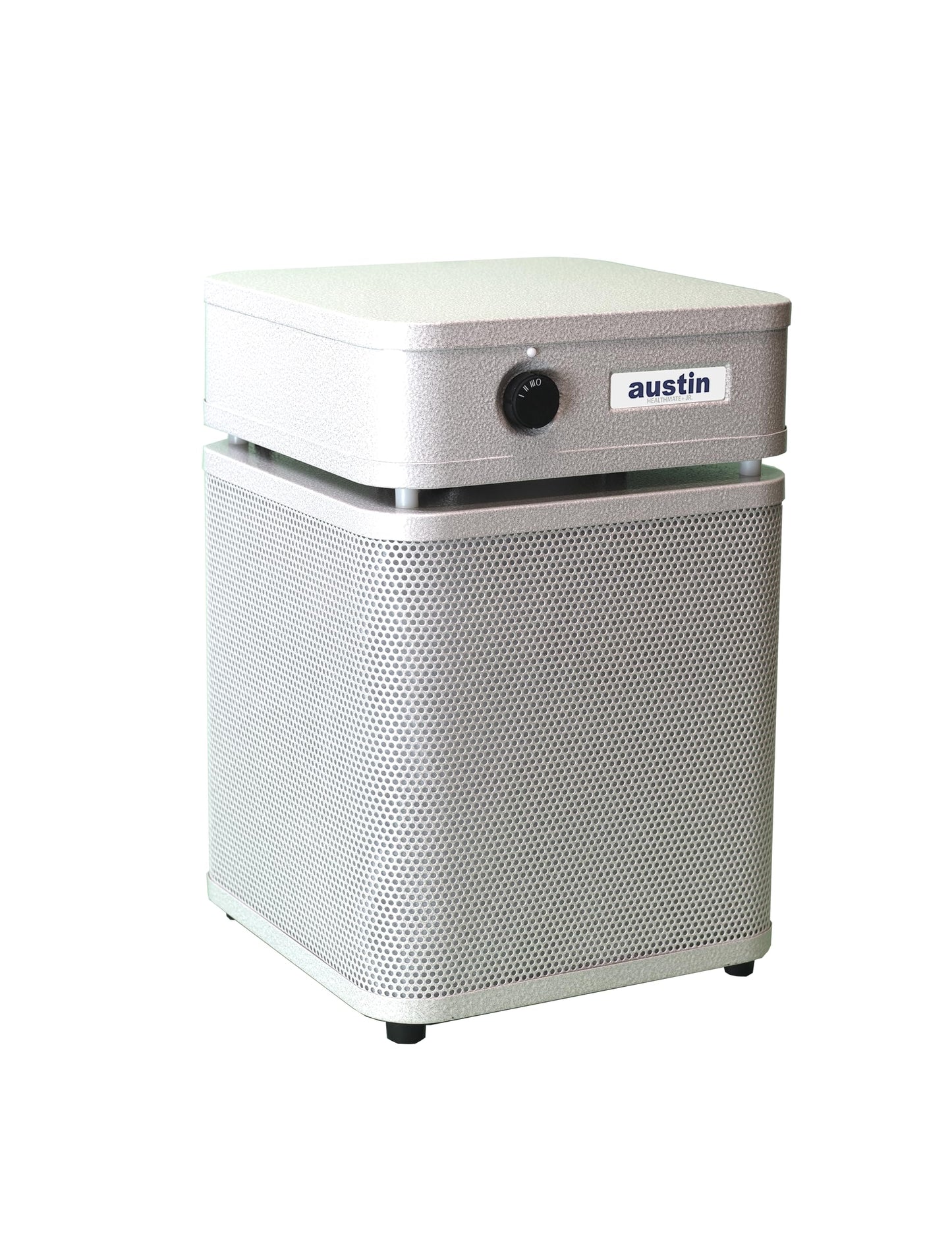
Austin Air HealthMate Plus Junior (A250): Non-Toxic Steel Air Purifier for VOCs in Small Rooms
Why We Choose Austin Air HealthMate Plus Junior
The Austin Air HealthMate Plus Junior is the small-room version of Austin's chemical-focused purifier, and it is the model to look at when your concern is gases and chemical odors in a single room rather than dust across a whole floor. It is a compact, all-steel unit built in Buffalo, New York, and almost everything that makes it worth the price sits in one place most purifier marketing skips over, which is the kind and the quantity of carbon it carries. If your reason for buying is volatile organic compounds from paint, new furniture, adhesives, smoke, or cleaning products in a bedroom, nursery, or office, this is a purifier worth understanding in detail. If your reason is mainly pollen and pet dander, you can spend a good deal less and still be happy, and we will explain where that line falls. And if the space you want to clean is larger than a single room, the full-size HealthMate Plus is the better fit, which we will also be honest about below.
What the "Plus" actually changes
Austin sells the Junior in two versions that look almost identical from the outside. The standard HealthMate Junior and the HealthMate Plus Junior share the same steel cabinet, the same four-stage layout, and the same true HEPA stage. The difference is the chemical media. The Plus replaces part of the standard carbon bed with carbon that has been impregnated with potassium iodide, which targets a wider range of VOCs and acidic gases, formaldehyde among them, more aggressively than the standard model does.
That is the whole reason the Plus exists, and it is the one detail that should drive your decision. A buyer worried about off-gassing from a remodel, new cabinetry, or household chemicals benefits from the Plus. A buyer worried about seasonal allergies is paying extra for chemical media they will not lean on, and the standard Junior is the more sensible choice.
The four stages, in order:
1. Large-particle pre-filter
2. A medium-particle pre-filter
3. The activated carbon and zeolite bed of roughly six and a half pounds of media impregnated with potassium iodide, which is the part competitors measure in grams,
4. And a true medical-grade HEPA stage rated to capture 99.97 percent of particles at 0.3 microns.
It is worth being honest about scale here. This is a smaller filter than the full-size HealthMate Plus, which carries about fifteen pounds of carbon and sixty square feet of HEPA. The Junior carries roughly six and a half pounds of carbon and thirty square feet of HEPA. You are trading filtration capacity for a unit that is smaller, lighter, more portable, and less expensive. For a single room with a real chemical concern, that trade is often exactly right. For a large open space or a heavy continuous load, it is not, and we will point you to the bigger unit where that applies.
Coverage:
Austin rates the HealthMate Plus Junior for spaces up to about 700 square feet, and that figure is the upper bound at a gentle air-exchange rate. For the higher turnover that matters most for someone with chemical sensitivity or asthma, treat this as a single-room unit, a bedroom, nursery, or office, well under that 700 number, rather than something to spread across an open floor plan.
Size it to one room and it performs as it should. Stretch it across a whole level and it will not keep up, and you would be better served stepping up to the full-size HealthMate Plus, which is built for up to 1,500 square feet.
The honest tradeoffs:
The reasons not to buy this are as useful as the reasons to buy it, and a buyer who only hears the upside has been sold rather than helped.
1. It is expensive relative to mass-market purifiers, and most of that premium is the carbon and the steel build rather than features.
2. It is far more portable than the full-size unit, in the low twenties for weight and about 16.5 inches tall on an 11-inch square footprint, so it is genuinely easy to move from room to room, though it is worth knowing that the Junior does not ship with wheels and they are an optional add-on.
3. It is loud on its highest setting, in the mid-sixties of decibels, which is the tradeoff for moving real volumes of air, and quiet enough to sleep beside only on low, closer to forty decibels.
4. It is also deliberately simple, with a three-speed analog dial and no air-quality sensor, no app, and no automatic mode. If you want a screen that reports a particle count or a purifier that adjusts itself, this is not that product, and you should know that before ordering rather than after.


Our Take: The True Shift Score (7.8/10)
A quick note on the number below. This is our own assessment, not a lab result or a certification. It reflects how we weigh the things a non-toxic home actually depends on, which means materials and durability and waste count for more in our scoring than features or convenience do. Someone whose priority is a quiet bedroom unit with an app would weight it differently, and that is fair. We would rather show you the reasoning behind the number than hand you a score with nothing under it.
Non-Toxic Build: 9 / 10
A steel cabinet with a baked-on powder coat rather than plastic, so the unit itself does not off-gas the way some plastic-bodied purifiers do when new. We hold back the last point only because not every internal component and adhesive is publicly disclosed.
Filtration Performance: 8 / 10
Strong for a small-room VOC unit, thanks to the potassium-iodide carbon paired with true HEPA. Not higher because the six-and-a-half-pound carbon bed and thirty square feet of HEPA are modest in absolute terms, and it makes no ultrafine-particle claim the way some pricier units do.
Durability and Longevity: 8 / 10
The steel build is excellent and made to last for years. The point comes off because the smaller carbon bed saturates faster under load than the full-size unit's, so filter longevity is more caveated than the headline five-year figure suggests.
Waste Reduction: 8 / 10
Even at two to three years under heavy use, the filter life means far fewer cartridges thrown away over time than a disposable-filter machine, which is the kind of quiet, structural waste reduction we value most.
Ease of Use: 7 / 10
More portable than the full-size unit at around twenty pounds and easy to move between rooms, which earns it a point back. Still deliberately simple though, with an analog dial and no sensor, app, or auto mode, loud on its highest setting, and no wheels included.
Value Over Time: 7 / 10
A real upfront cost for a small-room unit. It pays back through longevity if you keep it and size it to the right room, but if all you need is particulate filtering, less expensive units will do that job for less.
Overall, our 7.8 leans on the dimensions we weight most heavily for healthy-home living, and it happens to land essentially at the average of the marks above, which tells you we did not need to inflate any single number to like it.
When a different purifier is the better call
- Against the standard HealthMate Junior, choose the Plus Junior only if VOCs, formaldehyde, or chemical odors are your actual concern, because that is what the potassium-iodide carbon is for. For dust, dander, and pollen alone, the standard Junior uses the same HEPA and the same build for less money, and the extra chemical media on the Plus would go underused.
- Against the full-size HealthMate Plus, step up if your room is bigger than a bedroom or office, or if you have a heavy and continuous chemical load such as wildfire smoke or an active remodel across an open plan. The full-size carries more than twice the carbon, about fifteen pounds against six and a half, twice the HEPA at sixty square feet against thirty, covers up to 1,500 square feet, and includes wheels. The Junior is the right call for a single room, a tighter budget, and easy portability, and the full-size is the right call when the space or the load outgrows that.
- Against mass-market units like Coway or Levoit, those are reasonable choices for budget particulate filtering with smart features and app control, but they carry a fraction of the carbon and need filter changes far more often, so they are not a serious answer to a chemical-sensitivity problem. Buy them for allergies and a tight budget, not for VOC removal.
- Against the IQAir HealthPro Plus, that is a different and considerably pricier class focused on capturing ultrafine particles below what a standard HEPA targets. If sub-0.3-micron capture is your priority, look there and expect to pay for it. If your concern is gases and chemical load in a small room, the Austin's treated carbon is the more relevant tool for the money.
The real cost over time
The case for an Austin is genuinely about the long filter life, but the figure has to be defensible rather than dramatic, so here is how to think about it. The main filter is rated for up to five years of normal residential use, with the prefilters changed more often. A typical mass-market purifier needs its main filter replaced every six to twelve months. Over a five-year window, that is one Austin filter against five to ten replacement filters on a disposable-filter machine.
One caveat specific to the Junior is worth stating plainly. Its carbon bed is smaller than the full-size unit's, so under a heavy or continuous chemical load the carbon saturates sooner, and real-world filter life can land closer to two or three years rather than the full five. That is still far better than swapping filters twice a year, but you should size your expectations to your actual use rather than assume five years in every case. Whether it nets out to a saving depends on the current prices of each filter, so the right way to read it is to put today's numbers into that five-to-ten-filter comparison rather than to quote a fixed lifetime total.
FREQUENTLY ASKED QUESTIONS
Does it remove airborne microplastics?
It captures airborne particles at 99.97 percent down to 0.3 microns, which includes many airborne microplastic fragments. It is accurate to say it captures a large share of airborne particulate, and not accurate to claim it removes every microplastic, since the very smallest are below the size the HEPA stage is rated for.
Is the housing non-toxic?
The cabinet is steel with a baked-on powder coat rather than plastic, which is a meaningful point for buyers sensitive to plastic off-gassing, since the unit itself does not contribute the kind of emissions some plastic-bodied purifiers do when new.
How often do filters need changing?
The main filter is rated for up to five years under normal residential use, with prefilters changed more frequently. Because the Junior's carbon bed is smaller, heavy or continuous chemical load shortens that to roughly two or three years, so treat five years as a ceiling rather than a guarantee.
What size room does it suit?
Plan around a single room up to roughly 700 square feet for general filtering, and noticeably smaller, a bedroom or office, if you want a high air-change rate for sensitivity or asthma. If your space is larger than that, the full-size HealthMate Plus is the better match.
Does it help with VOCs from paint or new furniture?
Yes, this is the specific scenario the Plus is built for, because of its potassium-iodide carbon. This is the main reason to choose it over the standard HealthMate Junior.
Should I get this or the full-size HealthMate Plus?
Get the Junior for a single room, easy portability, and a lower price. Step up to the full-size if your space is larger than a bedroom or office, or if your chemical load is heavy and continuous, since the full-size carries more than twice the carbon and covers up to 1,500 square feet.
Why pick this over a cheaper purifier?
For dust and allergies, you may not need to. The case for the Plus Junior is chemical and gas filtration backed by real carbon mass, plus a steel build and a long filter life. If those are not your priorities, a less expensive unit is the sensible choice.
How we evaluate products
Rather than a single score, here is the basis for the recommendation. We weighted carbon type and mass heavily because this is a VOC-focused category, considered the steel build for buyers avoiding plastic emissions, factored the long filter life against ongoing replacement cost with the Junior's smaller carbon bed in mind, and set the recommendation against named alternatives so the choice is contextual rather than absolute.
Looking for non-toxic product swaps? Read our guides on Water and Air Protection and the microplastics effect on human health
Best Water Filter for Microplastics & PFAS in 2026
Water Filtration Made Simple
MAKE THE TRUE SHIFT TODAY
Check current price and availability on AmazonTake the Shift Further
The True Shift Non-Toxic Home Swaps
-
WATER & AIR PROTECTION
Most families don’t realize that "clear" water and "fresh" air can hide...
-
MICROPLASTIC-FREE KITCHEN
Truth Check: Just because a container is "BPA-Free" doesn't mean it’s safe....
-
CHEMICAL-FREE BATH & BODY
Your skin is your body's largest organ, and it absorbs everything you...
-
NON-TOXIC BABY & KIDS' ESSENTIALS
Protect your most vulnerable family members. Vetted, non-toxic alternatives for feeding gear,...
-
HEALTHY HOME OFFICE
Maximize health and focus while you work. Solutions for reducing VOCs from...
-
NON-TOXIC SLEEP & LAUNDRY
Did you know your bed is often the place where chemicals mess...
Microplastic Guides
-
The Plastic-Free Diet 2026: Your 30-Day Bluepri...
The complete 30-day guide to eliminate microplastics, PFAS & forever chemicals from your home. Science-backed steps, product swaps, and real results.
The Plastic-Free Diet 2026: Your 30-Day Bluepri...
The complete 30-day guide to eliminate microplastics, PFAS & forever chemicals from your home. Science-backed steps, product swaps, and real results.
-
How to Create a Healthy Home: A Practical Guide...
Tired of living in a space that doesn’t support you? Learn how to create a healthy, non-toxic home that reflects your core values & goals in just 5 simple steps.
How to Create a Healthy Home: A Practical Guide...
Tired of living in a space that doesn’t support you? Learn how to create a healthy, non-toxic home that reflects your core values & goals in just 5 simple steps.
-
Beyond Plastic: The Modern Approach to Home Org...
Ditch cheap plastic bins and containers for beautiful, non-toxic alternatives. Reduce microplastics, save money, and create a calmer, healthier home with these modern strategies.
Beyond Plastic: The Modern Approach to Home Org...
Ditch cheap plastic bins and containers for beautiful, non-toxic alternatives. Reduce microplastics, save money, and create a calmer, healthier home with these modern strategies.
-
AI for a Toxin-Free Home in 2026: How It Create...
Discover how AI for a toxin-free home works in 2026. Get an AI-powered healthy home audit, personalized swaps, and science-backed recommendations to eliminate microplastics, PFAS & phthalates effortlessly.
AI for a Toxin-Free Home in 2026: How It Create...
Discover how AI for a toxin-free home works in 2026. Get an AI-powered healthy home audit, personalized swaps, and science-backed recommendations to eliminate microplastics, PFAS & phthalates effortlessly.
Sign up for the latest from The True Shift
Receive updates on Healthy Home hacks, lifestyle tips, and other sustainability news.