
Ceraflame 100% Pure Ceramic Cookware Set
The Real Ceramic, Not the Coated Kind
The most important thing to understand about Ceraflame is the thing most "ceramic cookware" quietly hides: this is 100% solid ceramic, fired all the way through, not a ceramic coating sprayed onto metal. That single distinction is why it sits in a different league from the ceramic nonstick pans, and it is the heart of this review.
"Pure ceramic" vs "ceramic nonstick," the difference nobody explains
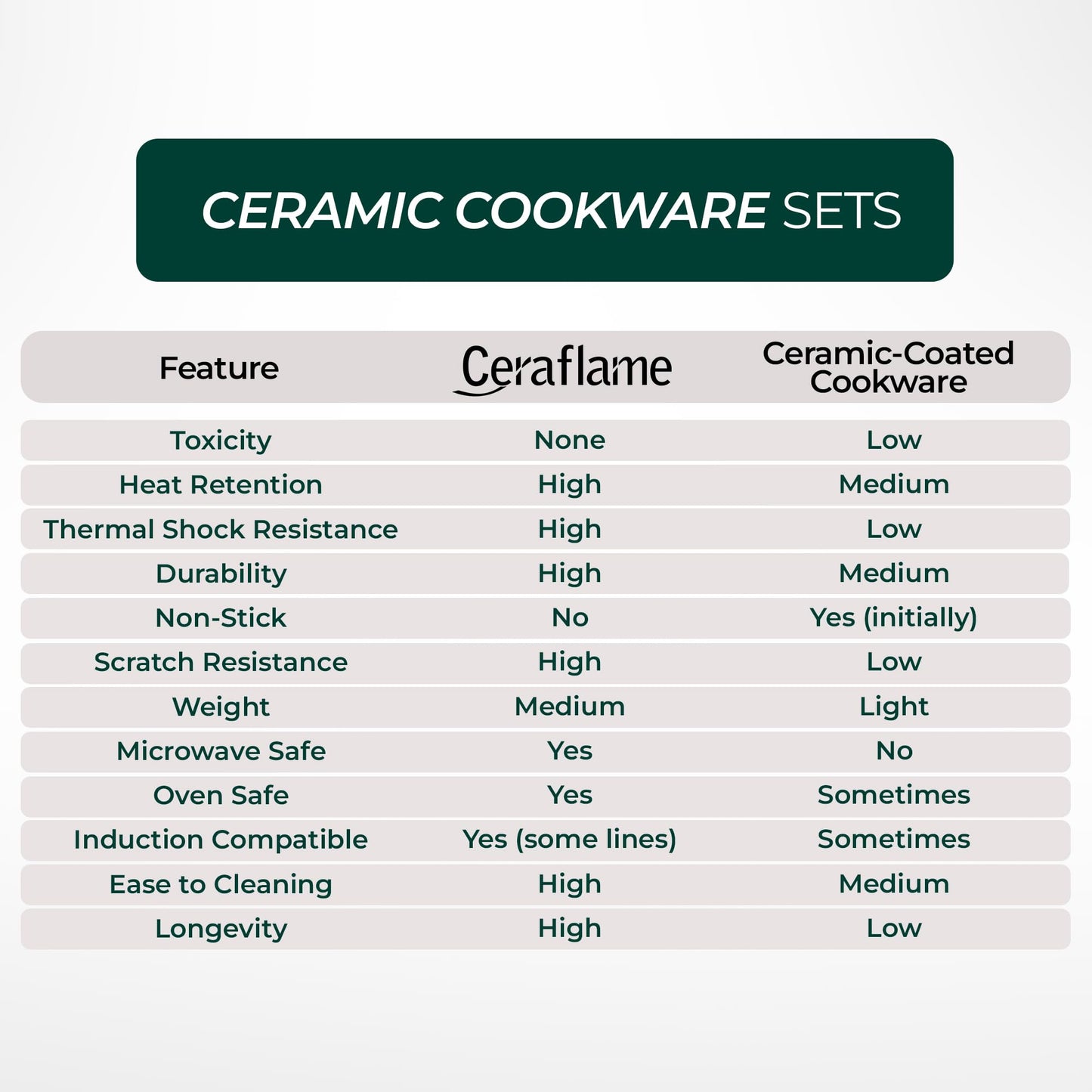
When a pan is labeled "ceramic," it almost always means ceramic nonstick: a thin sol-gel coating over an aluminum body. That coating is free of PTFE and PFOA, which is genuinely good, but it is still a coating, and it wears down within a few years, after which you are cooking on whatever is underneath it. Ceraflame is the other thing entirely, solid ceramic to the core, handcrafted in Brazil by a family company that has made it since 1956. There is no coating to wear off and no metal underneath, so it cannot scratch through to anything, cannot flake, and will look the same in twenty years. If you have ever bought a "ceramic" pan expecting it to last and watched it degrade, this is the distinction that explains why.
Why it is the most inert surface you can cook on
1. Because it is just fired ceramic, there is nothing to leach: no PFAS, no PTFE, no coating, and no metal, which Ceraflame states includes being free of heavy metals like cadmium.
2. It is non-porous, so it does not hold onto oils or odors, and it is completely unreactive, which makes it genuinely excellent for the acidic, long-cooked foods, tomato sauces, citrusy braises, that can pull a metallic taste out of even good stainless or strip the seasoning off cast iron.
3. If maximum inertness is your priority, this is arguably the safest cooking surface there is.
4. It is also oven safe to a remarkable 1200°F and moves from freezer to flame, microwave, and dishwasher.
The honest tradeoffs
Real ceramic buys that inertness with two real costs.
First, it is breakable. Ceraflame is engineered to resist thermal shock, which is the freezer-to-flame trick, but it is still ceramic, so a hard knock or a drop can chip or crack it in a way that will never happen to cast iron or steel. It rewards careful handling.
Second, it does not work on induction, because there is no magnetic metal in it, so if you have an induction cooktop, this is not your pan. It also heats more slowly and is not a slick nonstick surface, so you cook with a little fat and a little patience, closer to the feel of stainless than of a coated pan. None of these make it worse. They make it a specific tool: the one to choose when inertness matters most and you are willing to handle it with care.

Our Take: The True Shift Score (8.4 / 10)
A note on the number below. This is our own assessment, not a lab result or a certification, and we weight materials, durability, and waste most heavily.
Cooking Surface Safety: 10 / 10
The most inert surface here, solid ceramic with no coating and no metal, completely unreactive even with acidic foods. Nothing to leach, ever.
Build & Materials: 9 / 10
Handcrafted solid ceramic from a maker with nearly 70 years at it, docked one point only because ceramic is inherently more fragile than metal.
Durability & Longevity: 8 / 10
Chemically it never degrades, but it can crack or shatter if dropped, unlike the near-indestructible cast iron and steel options, so longevity depends on careful handling.
Waste Reduction: 9 / 10
Lasts indefinitely if unbroken, is recyclable, and takes less energy to produce than metal cookware.
Ease of Use: 6 / 10
It will not work on induction, it asks for careful handling, it heats slowly, and it is not effortless nonstick, though it is scratch-proof, non-porous, and dishwasher-safe.
Value Over Time: 7 / 10
Fair value for a genuinely unique product, with the fragility and the induction limitation keeping it from scoring higher.
Overall, our 8.4 reflects the most chemically inert cooking surface in this collection, ideal for acidic and long-cooked foods, scored honestly against its fragility and the fact that it will not work on induction.
When something else is the better fit
If you cook on induction, this is not your pan, since ceramic is not magnetic, so reach for stainless or cast iron. If you want cookware you never have to baby, metal shrugs off the knocks and drops that can crack ceramic. And if effortless nonstick release is the priority, a PTFE-free ceramic nonstick pan does that as a consumable. The case for pure ceramic is the cook for whom maximum inertness, especially with acidic and long-cooked foods, matters more than ruggedness or induction.
Common questions about the Ceraflame Cookware
Is Ceraflame really non-toxic?
Yes. It is 100% solid ceramic with no coating, no PFAS, no PTFE, and no metal, which the maker states includes being free of heavy metals like cadmium. There is simply nothing in it to leach into food.
What is the difference between pure ceramic and ceramic nonstick?
Pure ceramic, like Ceraflame, is solid ceramic all the way through, with no coating to wear out. Ceramic nonstick, like Our Place, Caraway, and GreenPan, is a sol-gel coating over a metal body that is free of PTFE and PFOA but wears down within a few years. They are very different products that share a confusing name.
Does Ceraflame work on induction?
No. Ceramic is not magnetic, so it will not work on an induction cooktop. It works on gas, electric, radiant, and similar stoves, plus the oven, microwave, and grill.
Is pure ceramic nonstick?
Not in the way a coated pan is. It is a smooth, non-porous surface, so food releases reasonably well with a little oil, but you cook with fat rather than expecting effortless release.
Can Ceraflame break?
Yes. It is engineered to resist thermal shock, so it can go from freezer to flame, but it is still ceramic, so a drop or hard knock can chip or crack it. It needs a more careful hand than metal cookware.
Can I cook acidic foods in it?
Yes, and that is one of its biggest advantages. Because it is completely unreactive, it handles tomato sauces and citrusy dishes without the metallic taste or seasoning loss that metal cookware can have.
How we evaluate products
Here is the basis for the recommendation. We credited the most inert surface in the lineup, solid ceramic with nothing to coat or leach, and its real advantage with acidic foods, then drew the honest lines on its fragility, its incompatibility with induction, and its slower, non-nonstick cooking feel, so you can tell whether it is the right tool for your kitchen.
Looking for non-toxic product swaps? Read our guides on Kitchen and the microplastics effect on human health:
Microplastics in Plastic Cutting Boards
Toxin-Free Kitchen 2026
Produce Storage Hacks 2026
MAKE THE TRUE SHIFT TODAY
Check current price and availability on AmazonTake the Shift Further
The True Shift Non-Toxic Home Swaps
-
WATER & AIR PROTECTION
Water & Air Protection for a Healthier Home The water you drink...
-
MICROPLASTIC-FREE KITCHEN
The Heart of a Non-Toxic Home The kitchen is where a lot...
-
CHEMICAL-FREE BATH & BODY
Your skin is your body's largest organ, and it absorbs everything you...
-
NON-TOXIC BABY & KIDS' ESSENTIALS
Protect your most vulnerable family members. Vetted, non-toxic alternatives for feeding gear,...
-
HEALTHY HOME OFFICE
Maximize health and focus while you work. Solutions for reducing VOCs from...
-
NON-TOXIC SLEEP & LAUNDRY
Did you know your bed is often the place where chemicals mess...
Microplastic Guides
-
The Plastic-Free Diet 2026: Your 30-Day Bluepri...
The complete 30-day guide to eliminate microplastics, PFAS & forever chemicals from your home. Science-backed steps, product swaps, and real results.
The Plastic-Free Diet 2026: Your 30-Day Bluepri...
The complete 30-day guide to eliminate microplastics, PFAS & forever chemicals from your home. Science-backed steps, product swaps, and real results.
-
How to Create a Healthy Home: A Practical Guide...
Tired of living in a space that doesn’t support you? Learn how to create a healthy, non-toxic home that reflects your core values & goals in just 5 simple steps.
How to Create a Healthy Home: A Practical Guide...
Tired of living in a space that doesn’t support you? Learn how to create a healthy, non-toxic home that reflects your core values & goals in just 5 simple steps.
-
Beyond Plastic: The Modern Approach to Home Org...
Ditch cheap plastic bins and containers for beautiful, non-toxic alternatives. Reduce microplastics, save money, and create a calmer, healthier home with these modern strategies.
Beyond Plastic: The Modern Approach to Home Org...
Ditch cheap plastic bins and containers for beautiful, non-toxic alternatives. Reduce microplastics, save money, and create a calmer, healthier home with these modern strategies.
Sign up for the latest from The True Shift
Receive updates on Healthy Home hacks, lifestyle tips, and other sustainability news.
