Non-Toxic Organic Bamboo Cutting Board, XL, FSC – Greener Chef
The Renewable, Lightweight Board That Solves the Glue Problem
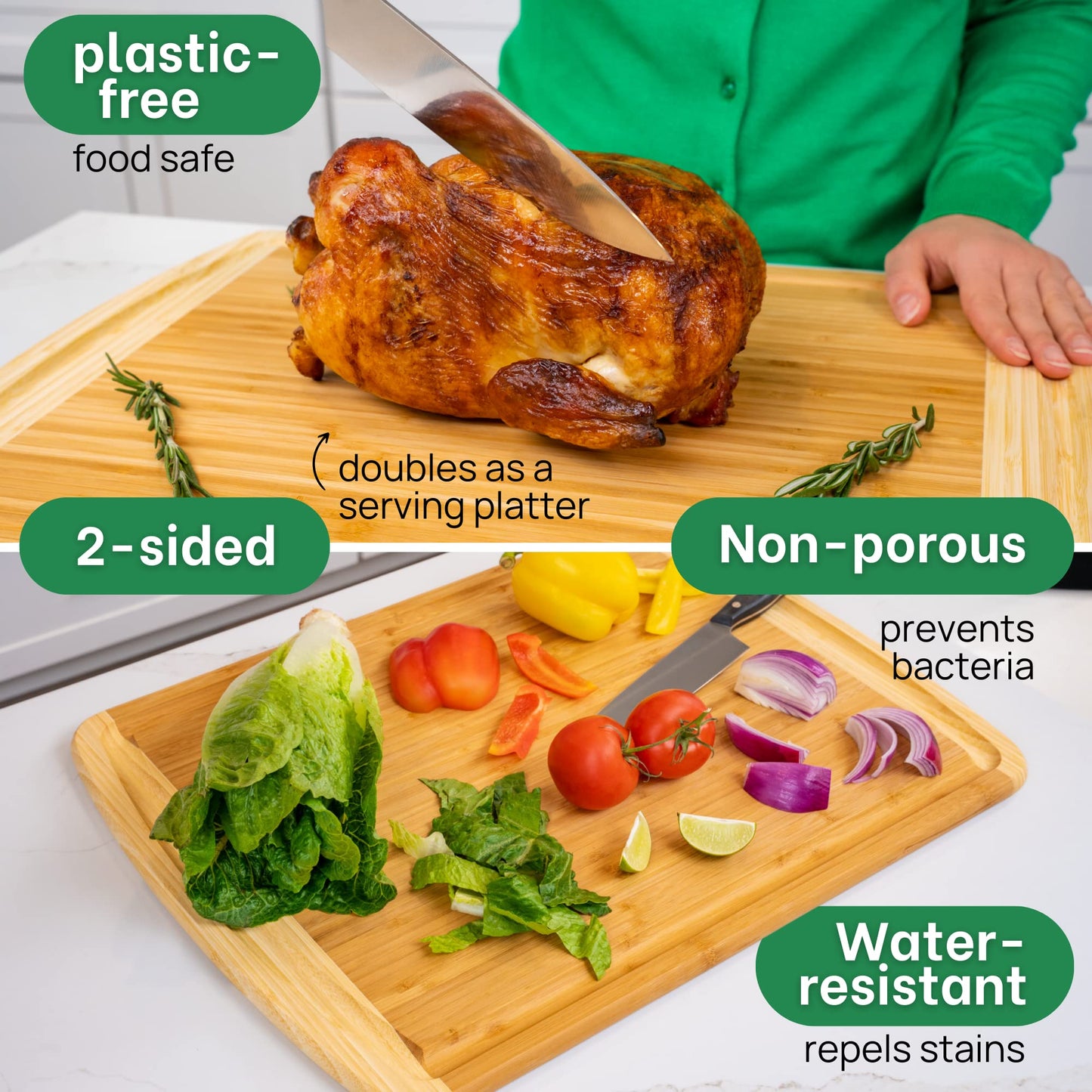
Bamboo is the budget-friendly, fast-renewing option in a non-toxic kitchen, and the Greener Chef XL is one of the better-made versions of it. Bamboo is technically a grass, one of the fastest-growing plants there is, which is what makes it genuinely sustainable, and Greener Chef uses FSC-certified organic Moso bamboo, a real third-party forestry certification for responsible sourcing. As a plant-based, inert surface, it sheds no microplastics into your food.
The thing most bamboo boards get wrong is the glue, and this is where Greener Chef stands apart. Cheaper bamboo is laminated from strips using formaldehyde-based adhesives, which is the honest health concern with the category. Greener Chef uses a patent-pending glue-free cutting surface, meaning the face you cut on is bonded without glue, and the adhesive that holds the board together is formaldehyde-free and stays sealed inside, never touching your food. The board is also free of phthalates, BPA, BPS, and BPF. That directly answers the one real worry with bamboo, and it comes with a lifetime replacement warranty against cracking, warping, or splitting, which tells you the maker stands behind it.
At a large 18-inch footprint and well under the weight of a hardwood block, it is easy to lift, easy to store, and easy to handle, which is a big part of bamboo's everyday appeal.
True Shift Score: 8.0 / 10
This is our own assessment, not a lab result or a certification.
Bamboo sits a clear step below the solid hardwood boards, and that is honest: it is harder on knives, it is a laminated product rather than solid wood, and it is thinner and lighter. What lifts this particular board to the top of its category is that Greener Chef actually solves bamboo's real problem, the glue, with a formaldehyde-free, glue-free cutting surface, backs it with FSC sourcing and a lifetime warranty, and delivers it at a fraction of the price and weight of a hardwood block. As the renewable, affordable, lightweight choice, it is an easy recommendation; it simply is not as kind to knives as solid hardwood.
The Honest Tradeoffs
1. The honest knock on bamboo is hardness. Bamboo is harder than soft hardwoods like cherry, walnut, or maple, so it will dull your knives a little faster than those will.
2. It is still far gentler than glass, stone, ceramic, or steel, and Moso bamboo is on the softer end of the bamboo range, but if pampering high-end knives is your top priority, a soft hardwood board is the kinder surface.
3. Bamboo is also a thinner, lighter board than a butcher block, and like all real wood it needs hydration: hand wash it, dry it, and oil it about monthly, or it can dry out and eventually crack.
4. And while Greener Chef is a US-based brand, the boards themselves are manufactured overseas, which is worth knowing if domestic production matters to you.
How We Evaluate Cutting Boards
We look at four things, and none of them is a lab score:
1. Whether the material sheds microplastics
2. How kind it is to your knives
3. Whether any glue or finish is food-safe
4. And how well it lasts with normal care
Cutting boards are a microplastics-and-glue question, not a PFAS one, despite what some guides imply.

When Something Else Is the Better Fit
If your priority is the gentlest possible surface for fine knives, a soft-hardwood board like the WoodForChef walnut or a cherry board is easier on edges. If you want several sizes for different jobs, the Greener Chef bamboo set is the better value. And for raw meat with hard scrubbing, a stainless steel board is the most hygienic, accepting that metal dulls knives.
Related Reading and Collections
For the full science on why plastic boards shed and how the materials compare, read our guide to microplastics in cutting boards, and for the wider picture on PFAS and microplastics across the kitchen, see our non-toxic kitchen guide. To weigh other options, browse the full Sustainable Cutting Boards collection, or step back to the Microplastic-Free Kitchen hub for cookware, cooking tools, and food storage. If you would like to work through your whole home step by step, our DIY Healthy Home Guidebooks are a practical place to start.
Frequently Asked Questions
Is bamboo bad for knives?
Bamboo is harder than soft hardwoods like cherry, walnut, or maple, so it dulls knives a little faster than those. It is still much gentler than glass, stone, ceramic, or steel. For everyday cooking it is fine; for protecting expensive knives, a soft hardwood is gentler.
Does this bamboo board contain formaldehyde glue?
No. The cutting surface is glue-free, and the adhesive that holds the board together is formaldehyde-free and stays sealed inside, away from food. That is the main thing to look for in bamboo, since cheaper boards often use formaldehyde-based glues.
How do I keep it from cracking?
Bamboo needs hydration. Hand wash it, dry it promptly, never put it in the dishwasher, and rub it with food-grade mineral oil about once a month. That keeps it from drying out and splitting, and the lifetime warranty covers it if it does.
About This Product
This board is fulfilled through Amazon, which handles pricing, availability, and shipping. The True Shift earns a commission on qualifying purchases, and that is what keeps this work independent and reader-supported rather than funded by the brands being reviewed.
MAKE THE TRUE SHIFT TODAY
Check current price and availability on AmazonTake the Shift Further
The True Shift Non-Toxic Home Swaps
-
WATER & AIR PROTECTION
Water & Air Protection for a Healthier Home The water you drink...
-
MICROPLASTIC-FREE KITCHEN
The Heart of a Non-Toxic Home The kitchen is where a lot...
-
Non-Toxic Bath & Body
What Goes On Your Body Matters as Much as What Goes In...
-
NON-TOXIC BABY & KIDS' ESSENTIALS
Protect your most vulnerable family members. Vetted, non-toxic alternatives for feeding gear,...
-
HEALTHY HOME OFFICE
Maximize health and focus while you work. Solutions for reducing VOCs from...
-
NON-TOXIC SLEEP & LAUNDRY
Did you know your bed is often the place where chemicals mess...
Microplastic Guides
-
The Plastic-Free Diet 2026: Your 30-Day Bluepri...
The complete 30-day guide to eliminate microplastics, PFAS & forever chemicals from your home. Science-backed steps, product swaps, and real results.
The Plastic-Free Diet 2026: Your 30-Day Bluepri...
The complete 30-day guide to eliminate microplastics, PFAS & forever chemicals from your home. Science-backed steps, product swaps, and real results.
-
How to Create a Healthy Home: A Practical Guide...
Tired of living in a space that doesn’t support you? Learn how to create a healthy, non-toxic home that reflects your core values & goals in just 5 simple steps.
How to Create a Healthy Home: A Practical Guide...
Tired of living in a space that doesn’t support you? Learn how to create a healthy, non-toxic home that reflects your core values & goals in just 5 simple steps.
-
Beyond Plastic: The Modern Approach to Home Org...
Ditch cheap plastic bins and containers for beautiful, non-toxic alternatives. Reduce microplastics, save money, and create a calmer, healthier home with these modern strategies.
Beyond Plastic: The Modern Approach to Home Org...
Ditch cheap plastic bins and containers for beautiful, non-toxic alternatives. Reduce microplastics, save money, and create a calmer, healthier home with these modern strategies.
Sign up for the latest from The True Shift
Receive updates on Healthy Home hacks, lifestyle tips, and other sustainability news.
