
Skip to product information
1 of 17

WINIX T830 360-Degree Wi-Fi True HEPA Air Purifier for Large, Open Rooms

WINIX T830 360-Degree Wi-Fi True HEPA Air Purifier for Large, Open Rooms

Why We Choose WINIX T830

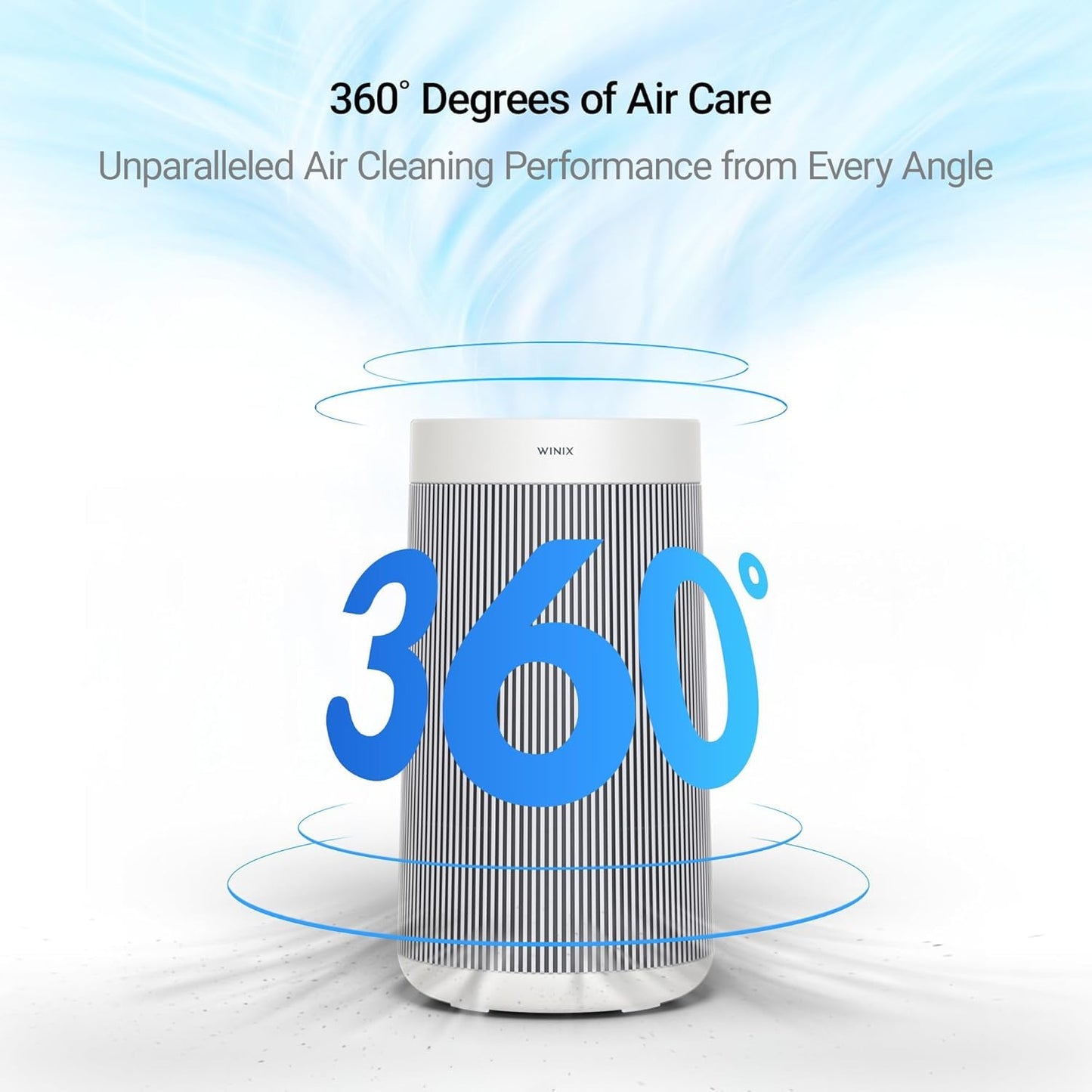
The WINIX T830 is the one to look at when you need to cover a large or open room and you want to see your air quality at a glance rather than through an app. It is the blue-finish version of the WINIX T810, the same machine in a different color, and it uses a 360-degree all-in-one design that pulls air in from every side. That layout lets it move a lot of air for its size and makes it suited to sitting out in the open, in the middle or corner of a room, rather than tucked against a wall. It is a strong particulate cleaner with the best onboard monitoring in the WINIX range. Like the rest of that range, it is a plastic-bodied unit with light carbon, so it is not a chemical-sensitivity machine, and we will be honest about that below.

What it is built for:

The T830 runs a 360-degree four-stage system: a fine-mesh pre-filter, a True HEPA filter that captures fine particles, an activated carbon layer for everyday odors, and WINIX's PlasmaWave technology. The True HEPA stage is the workhorse and handles dust, pollen, dander, and smoke well across a large area. Where this unit genuinely stands out is monitoring. It carries an onboard air-quality display and triple sensors, so you can read the room's air quality directly on the device without opening your phone, which is the best at-a-glance experience WINIX offers.

The carbon is the honest limitation. Like other recent WINIX units, the T830 uses an impregnated-carbon layer rather than a deep pellet bed, which keeps the all-in-one filter slim but means it is built to manage everyday odors, not to scrub heavy or continuous chemical loads. It reduces cooking smells, pet odor, and light VOCs, and that is the right expectation to hold.

A note on PlasmaWave for non-toxic-minded buyers. PlasmaWave is an ionizing technology, and WINIX states it produces no harmful ozone, with CARB certification behind that. If you would rather run pure mechanical filtration, you can switch it off and the HEPA and carbon stages keep working. Worth knowing it is there and that it is optional.

Coverage:

This is the large-room unit of the WINIX pair. WINIX markets it as cleaning extra-large rooms, on the order of around 2,000 square feet, once per hour, and the 360-degree intake is what lets it achieve that throughput without a bulky footprint. For a high air-change rate in a smaller space it is more than enough, and for an open-plan living area it is genuinely the right size, where the compact 5520 would fall short. If your space is a single bedroom or office, the smaller 5520 is the more sensible and less expensive choice.

The honest tradeoffs:

It is plastic-bodied, so no steel, no-off-gassing build like the Austin Air. Its carbon is light, so it is not a serious VOC tool. The all-in-one filter is convenient to install but more cumbersome to maintain, because cleaning the pre-filter means removing the whole cartridge, and filter access is through the bottom of the unit, which means tipping it to change it. It is quiet on lower speeds and loud at the top of its range, the usual tradeoff. The Winix app is clean and ad-free, which is a plus, but the onboard display is the real reason to choose this unit over a cheaper one.

View full details

Our Take: The True Shift Score (6.7 / 10)

A quick note on the number below. This is our own assessment, not a lab result or a certification. It reflects how we weigh the things a non-toxic home actually depends on, which means materials, durability, and waste count for more in our scoring than features or convenience do. A buyer who prioritizes a large-room smart unit with great monitoring would weight it differently, and that is fair.

Non-Toxic Build: 6 / 10

A plastic body, like most of its class, with PlasmaWave ionization included. WINIX says no harmful ozone and it is CARB certified, and the feature can be turned off, but a plastic cabinet and an ionizer are not what we reward most.

Filtration for Purpose: 7 / 10

Strong True HEPA particulate performance across a large area, helped by the 360-degree intake. Marked down because the impregnated carbon is light, so it is not a real answer to heavy VOCs or chemical odors.

Durability and Longevity: 6 / 10

A capable unit, but a plastic build and an all-in-one replaceable filter keep it behind steel, long-filter machines on longevity.

Waste Reduction: 5 / 10

The all-in-one filter is replaced as a whole cartridge, so there is more material per change and regular filter waste rather than a long-life design.

Ease of Use: 8 / 10

The onboard air-quality display and triple sensors are the standout, with Wi-Fi, auto mode, and flexible 360-degree placement. We hold a point back because filter access through the bottom is awkward.

Value Over Time: 7 / 10

A fair mid-range price for a large-room smart unit, offset by ongoing filter replacement. Good value if your space actually needs the coverage.

Overall, our 6.7 reflects a strong large-room particulate unit with excellent monitoring that does not lead on the build, materials, and waste dimensions we weight most. It earns a slight edge over the 5520 for coverage and on-device monitoring, and it is a smart-features choice rather than a non-toxic showpiece.

When a Different Purifier is the Better Call

  • For heavy VOCs, formaldehyde, or chemical sensitivity, the steel Austin Air HealthMate Plus Junior is the better tool, with far more carbon and a build that does not off-gas. The T830's light carbon is not in that category.
  • For a single bedroom or office on a tighter budget, the smaller WINIX 5520 covers the room for less and fits tighter spaces, and it adds a gas-sensing auto mode.
  • For the smallest ultrafine particles and a premium build, the IQAir HealthPro Plus XE captures far finer particles than any True HEPA unit and carries a more substantial carbon stage, at several times the price.
  • Against mass-market large-room rivals like the Levoit 400S or Coway Airmega, the T830 holds its own, and the onboard air-quality display plus 360-degree placement are its genuine differentiators. The honest reason to choose it is large-room particulate cleaning with the best at-a-glance monitoring WINIX makes.

FREQUENTLY ASKED QUESTIONS

Is the WINIX T830 good for VOCs and chemical odors?
It manages everyday odors but does not deeply remove heavy chemical loads. The impregnated carbon is light, so for a real VOC or formaldehyde concern the steel, heavy-carbon Austin Air HealthMate Plus is the better tool.

Is the T830 the same as the T810?
Yes. The T830 is the blue-finish version of the silver T810, the same machine and the same internals, just a different color.

Does it produce ozone?
PlasmaWave is an ionizing feature, and WINIX states it produces no harmful ozone, supported by CARB certification. You can switch PlasmaWave off and the HEPA and carbon stages continue working.

What size room does it suit?
This is the large-room unit, marketed for extra-large spaces around 2,000 square feet at one air change per hour, and the 360-degree intake suits open-plan placement. For a single bedroom or office, the smaller 5520 is the better fit.

How is this different from the WINIX 5520?
The T830 is larger, uses a 360-degree design for open and extra-large rooms, and has an onboard air-quality display. The 5520 is compact, single-room, less expensive, and adds a gas-sensing auto mode. Choose by room size and placement.

How we evaluate products:

Rather than a single number, here is the basis for the recommendation. We weighted build materials and carbon capacity heavily because this is a non-toxic, VOC-aware category, noted plainly that the body is plastic and the carbon is light, credited the standout onboard monitoring and 360-degree coverage, flagged the optional PlasmaWave for ionizer-averse buyers, and set the unit against named alternatives so the choice is contextual rather than absolute.

Looking for non-toxic product swaps? Read our guides on Water and Air Protection and the microplastics effect on human health

Best Water Filter for Microplastics & PFAS in 2026
Water Filtration Made Simple