
Skip to product information
1 of 36

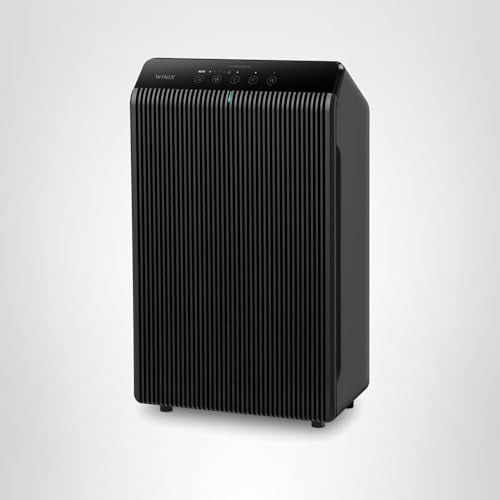
WINIX 5520 Wi-Fi True HEPA Air Purifier for Bedrooms and Small Rooms

WINIX 5520 Wi-Fi True HEPA Air Purifier for Bedrooms and Small Rooms

Why We Choose WINIX 5520

The WINIX 5520 is the unit to look at when you want capable everyday filtration and app control in a single room without spending a lot. It is the current Wi-Fi successor to the popular 5500-2, which WINIX discontinued in the United States in 2025, so the 5520 is what you actually buy now if you were shopping that line. It does a genuinely good job on the particles most homes deal with, dust, pollen, pet dander, and smoke, and it adds smart features the older model lacked. What it is not is a serious tool for heavy chemical loads, and we will be straight about that, because the honest version of this purifier is more useful than the marketing one.

What it is built for:

The 5520 runs a familiar WINIX filtration stack: a washable fine-mesh pre-filter for the large stuff, a True HEPA filter that captures fine particles, and an activated carbon layer for everyday odors, plus WINIX's PlasmaWave technology. The True HEPA stage is the heart of it and handles allergens and smoke well. The carbon layer is a thin replaceable filter rather than a deep bed, so it takes the edge off cooking smells, pet odor, and light household VOCs, but it is not built to scrub a room full of off-gassing from a remodel.

One feature worth knowing about is the sensor. The 5520's auto mode runs off a gas sensor rather than a particle sensor, which means it reacts to odors and airborne chemicals and ramps the fan when it detects them. That is a nice touch for a kitchen or a room with variable smells, though it is worth understanding the limitation honestly: the unit senses gases better than it deeply removes them, because the carbon is light. Think of it as VOC-aware rather than VOC-eliminating.

A note on PlasmaWave for anyone shopping with a non-toxic priority. PlasmaWave is an ionizing technology, and WINIX states it produces no harmful ozone, with CARB certification to back that up. If you would still rather run pure mechanical filtration, PlasmaWave can be switched off, and the HEPA and carbon stages keep working normally. We mention it because a buyer avoiding ionizers deserves to know it is there and that it is optional.

Coverage:

WINIX markets the 5520 with a large per-hour figure, cleaning sizable rooms once an hour, but its AHAM-style room rating and its measured CADR of roughly 249 put it in mid-size territory, genuinely comfortable in a bedroom, office, nursery, or similar single room rather than across an open floor plan. It also has a smaller body than the old 5500-2, so it fits tighter spaces, which is part of its appeal. Size it to one room and it performs. Ask it to cover an open great room and it will struggle, and the larger WINIX T830 or the IQAir is the better answer there.

The honest tradeoffs:

1. It is plastic-bodied, like most units in its price class, so it does not bring the steel, no-off-gassing build of the Austin Air

2. Its carbon is light, so it is not a chemical-sensitivity machine. 

3. It is only truly quiet on its lowest speed, where airflow is modest, and it gets loud at the top of its range, which is the usual tradeoff for moving real air. 

4. The Winix Smart app works and is ad-free, but it is fairly bare compared with what Levoit or Philips offer. 

5. And the replaceable Filter Q runs about eighty dollars a year, which is a real ongoing cost to factor in rather than a one-time purchase.


View full details

Our Take: The True Shift Score (6.5 / 10)

A quick note on the number below. This is our own assessment, not a lab result or a certification. It reflects how we weigh the things a non-toxic home actually depends on, which means materials, durability, and waste count for more in our scoring than features or convenience do. A buyer who prioritizes a quiet bedroom unit with an app would weight it differently, and that is fair.

Non-Toxic Build: 6 / 10

A plastic body, like most of its class, and it includes PlasmaWave ionization. WINIX says no harmful ozone and it is CARB certified, and the feature can be turned off, but a plastic cabinet and an ionizer are not what we reward most.

Filtration for Purpose: 7 / 10

Strong True HEPA particulate performance for a single room. Marked down because the carbon is a thin replaceable layer, so it is not a real answer to heavy VOCs or chemical odors.

Durability and Longevity: 6 / 10

A capable unit, but a plastic build and yearly filter replacement put it well behind steel, long-filter machines on longevity.

Waste Reduction: 5 / 10

The Filter Q is replaced about once a year and is a combined HEPA-and-carbon cartridge, so there is regular filter waste rather than a long-life design.

Ease of Use: 8 / 10

This is where it shines. Compact enough for tight spaces, Wi-Fi app control, an auto mode driven by a gas sensor, a remote, and a genuinely quiet lowest speed.

Value Over Time: 7 / 10

Low upfront cost for a capable single-room unit, offset by roughly eighty dollars a year in filters. Good value if you size it to one room.

Overall, our 6.5 reflects a good-value particulate unit that does not lead on the build, materials, and waste dimensions we weight most heavily. It is a sensible everyday choice, not a non-toxic showpiece, and we would rather say that plainly.

When a different purifier is the better call

  • For heavy VOCs, formaldehyde, or chemical sensitivity, the steel Austin Air HealthMate Plus Junior is the better tool, because it carries far more carbon and does not off-gas itself. The 5520's light carbon is not in the same category for gases.

  • For a large or open-plan space, step up to the WINIX T830, which uses a 360-degree all-in-one design to cover much bigger rooms and adds an onboard air-quality display.

  • For the smallest ultrafine particles, the IQAir HealthPro Plus XE captures down to a far finer level than any True HEPA unit, the 5520 included, though it costs many times more.

  • Against mass-market rivals like Levoit or Coway in the same price range, the 5520 is a solid, well-reviewed choice, and the gas-sensing auto mode is a genuine point of difference. The honest reason to pick it is dependable particulate cleaning with app control in a single room, at a fair price.

FREQUENTLY ASKED QUESTIONS

Is the WINIX 5520 good for VOCs and chemical odors?
It senses them and takes the edge off, but it does not deeply remove them. The gas sensor reacts to odors and chemicals and ramps the fan, but the carbon layer is light, so for a real VOC or formaldehyde concern the steel, heavy-carbon Austin Air HealthMate Plus is the better tool.

Does it produce ozone?
PlasmaWave is an ionizing feature, and WINIX states it produces no harmful ozone, supported by CARB certification. If you prefer purely mechanical filtration, you can switch PlasmaWave off and the HEPA and carbon stages continue working.

What size room does it suit?
Plan for a single room, a bedroom, office, or nursery, rather than an open floor plan. Its measured performance puts it in mid-size territory, and its compact body fits tighter spaces.

How much do filters cost to run?
The replaceable Filter Q is roughly eighty dollars and lasts up to about a year under normal use, so factor that ongoing cost into the low upfront price.

How is this different from the WINIX T830?
The 5520 is the compact, single-room, value unit with a gas-sensing auto mode. The T830 is larger, uses a 360-degree design for open and extra-large spaces, and adds an onboard air-quality display. Choose by room size and placement.

How we evaluate products:

Rather than a single number, here is the basis for the recommendation. We weighted build materials and carbon capacity heavily because this is a non-toxic, VOC-aware category, noted plainly that the body is plastic and the carbon is light, factored the yearly filter cost against the low upfront price, flagged the optional PlasmaWave for ionizer-averse buyers, and set the unit against named alternatives so the choice is contextual rather than absolute.

Looking for non-toxic product swaps? Read our guides on Water and Air Protection and the microplastics effect on human health

Best Water Filter for Microplastics & PFAS in 2026
Water Filtration Made Simple