
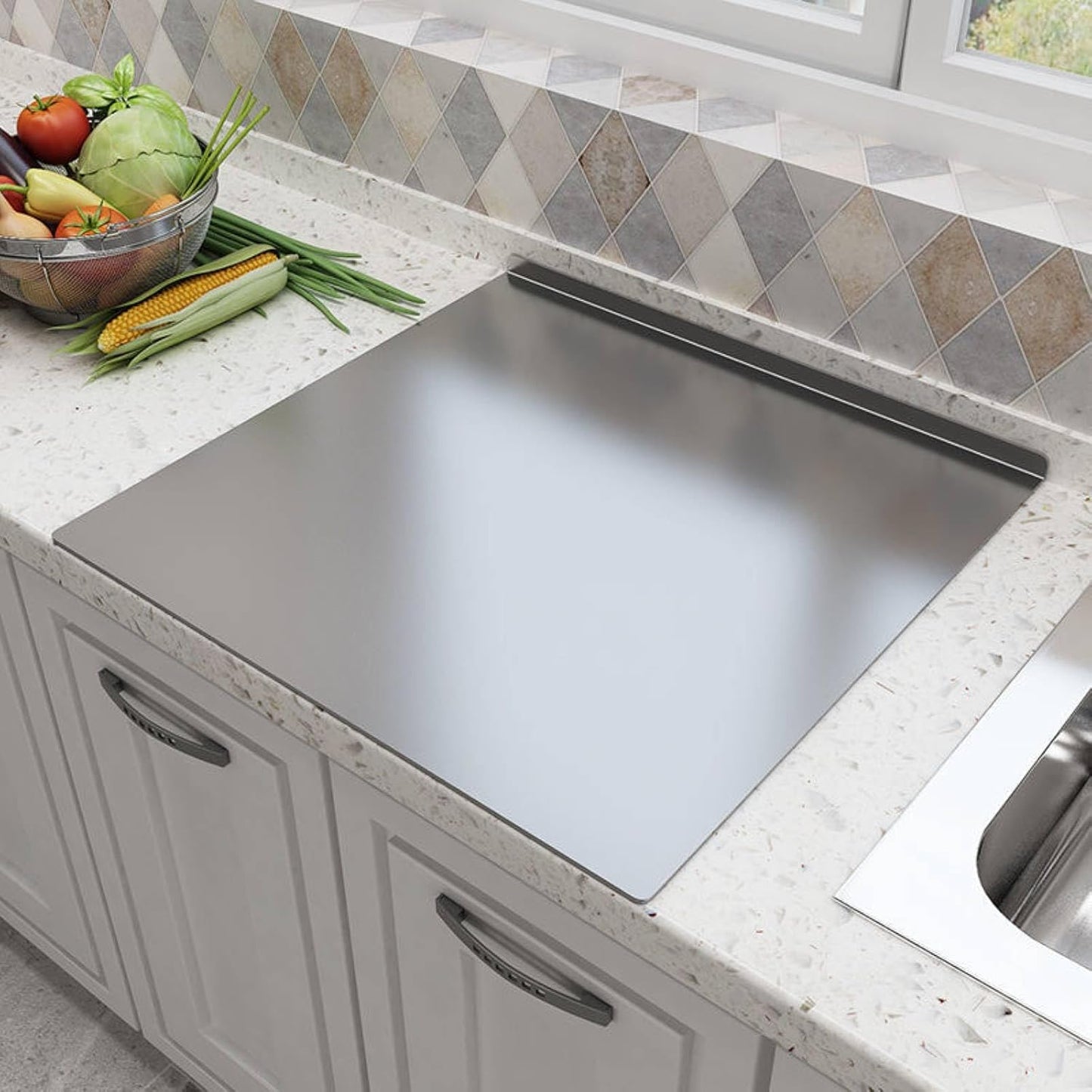
BILLAMB Stainless Steel Cutting Board
The Most Sanitary Surface in the Collection, With One Catch
The BILLAMB is a stainless steel cutting board, about 15.7 by 11.8 inches, a thin, lightweight sheet with non-slip silicone pads on the underside to keep it from sliding. Stainless steel is completely inert and nonporous, so it sheds nothing into your food, absorbs no liquids, holds no odors or stains, and rinses or wipes clean instantly. Best of all, it is dishwasher safe and can be fully sanitized, which is exactly why a metal surface shines for one job in particular: raw meat, poultry, and fish, where being able to scrub and sanitize without anything soaking in is a real hygiene advantage over wood.
It is also genuinely durable. It will not crack, splinter, warp, or wear out, it stores flat in a narrow space, and because it tolerates heat you can set it down near the stove without worry. As a clean, low-maintenance, raw-protein prep surface, it does a specific job very well.
True Shift Score: 6.5 / 10
This is our own assessment, not a lab result or a certification, and the score reflects suitability as an everyday cutting board.
It scores in the middle because of a real split: stainless is the most hygienic and one of the most durable surfaces here, inert, nonporous, dishwasher-safe, and excellent for raw protein, but it is hard on knives, which is a meaningful drawback for a tool whose main job is to be cut on. It edges out glass mainly because it will not shatter and its raw-meat sanitation use case is so strong, but if knife care matters to you, wood or rubber is the better daily board.
The Honest Tradeoffs
1. Now the catch, and it is the same one stone and glass have: stainless steel is hard, so it dulls knives.
2. Cutting on metal blunts your edges faster than wood, bamboo, rubber, or silicone will, and the smooth surface gives a knife little grip, so it can skate, and it is noisy to cut on.
3. This is a board to reach for when sanitation is the priority, not when knife care is.
4. Two more honest notes: it is a thin sheet rather than a hefty block, so it has a different feel than a butcher block, and the listing does not specify the steel grade, where 304 or 316 is the food-grade standard worth looking for in stainless.
How We Evaluate Cutting Boards
We look at four things, and none of them is a lab score:
1. Whether the material sheds microplastics
2. How kind it is to your knives
3. Whether any glue or finish is food-safe
4. And how well it lasts with normal care
Cutting boards are a microplastics-and-glue question, not a PFAS one, despite what some guides imply.

When Something Else Is the Better Fit
- For everyday chopping where you want to protect your knives, choose wood like the WoodForChef walnut or a cherry board, or the knife-friendly NoTrax rubber board, which matches stainless on hygiene while being gentle on edges.
- Reach for this stainless board specifically when you want a fully sanitizable, dishwasher-safe surface for raw meat and fish.
Related Reading and Collections
For the full science on why plastic boards shed and how the materials compare, read our guide to microplastics in cutting boards, and for the wider picture on PFAS and microplastics across the kitchen, see our non-toxic kitchen guide. To weigh other options, browse the full Sustainable Cutting Boards collection, or step back to the Microplastic-Free Kitchen hub for cookware, cooking tools, and food storage. If you would like to work through your whole home step by step, our DIY Healthy Home Guidebooks are a practical place to start.
Frequently Asked Questions
Does a stainless steel board dull knives?
Yes. Steel is hard, so cutting on it blunts knife edges faster than wood, bamboo, rubber, or silicone. It is best used where sanitation matters most, like raw meat, rather than as your everyday knife-care board.
Why use stainless steel at all then?
Hygiene and durability. It is nonporous, fully sanitizable, dishwasher safe, and will not absorb juices or bacteria, which makes it excellent for raw meat, poultry, and fish. It also will not crack, warp, or wear out.
Is stainless steel safe for food?
Yes, stainless is inert and sheds nothing into food. For the best corrosion resistance in the kitchen, food-grade grades like 304 or 316 are the standard to look for, though this particular listing does not state its grade.
About This Product
This board is fulfilled through Amazon, which handles pricing, availability, and shipping. The True Shift earns a commission on qualifying purchases, and that is what keeps this work independent and reader-supported rather than funded by the brands being reviewed.
MAKE THE TRUE SHIFT TODAY
Check current price and availability on AmazonTake the Shift Further
The True Shift Non-Toxic Home Swaps
-
WATER & AIR PROTECTION
Water & Air Protection for a Healthier Home The water you drink...
-
MICROPLASTIC-FREE KITCHEN
The Heart of a Non-Toxic Home The kitchen is where a lot...
-
CHEMICAL-FREE BATH & BODY
Your skin is your body's largest organ, and it absorbs everything you...
-
NON-TOXIC BABY & KIDS' ESSENTIALS
Protect your most vulnerable family members. Vetted, non-toxic alternatives for feeding gear,...
-
HEALTHY HOME OFFICE
Maximize health and focus while you work. Solutions for reducing VOCs from...
-
NON-TOXIC SLEEP & LAUNDRY
Did you know your bed is often the place where chemicals mess...
Microplastic Guides
-
The Plastic-Free Diet 2026: Your 30-Day Bluepri...
The complete 30-day guide to eliminate microplastics, PFAS & forever chemicals from your home. Science-backed steps, product swaps, and real results.
The Plastic-Free Diet 2026: Your 30-Day Bluepri...
The complete 30-day guide to eliminate microplastics, PFAS & forever chemicals from your home. Science-backed steps, product swaps, and real results.
-
How to Create a Healthy Home: A Practical Guide...
Tired of living in a space that doesn’t support you? Learn how to create a healthy, non-toxic home that reflects your core values & goals in just 5 simple steps.
How to Create a Healthy Home: A Practical Guide...
Tired of living in a space that doesn’t support you? Learn how to create a healthy, non-toxic home that reflects your core values & goals in just 5 simple steps.
-
Beyond Plastic: The Modern Approach to Home Org...
Ditch cheap plastic bins and containers for beautiful, non-toxic alternatives. Reduce microplastics, save money, and create a calmer, healthier home with these modern strategies.
Beyond Plastic: The Modern Approach to Home Org...
Ditch cheap plastic bins and containers for beautiful, non-toxic alternatives. Reduce microplastics, save money, and create a calmer, healthier home with these modern strategies.
Sign up for the latest from The True Shift
Receive updates on Healthy Home hacks, lifestyle tips, and other sustainability news.
