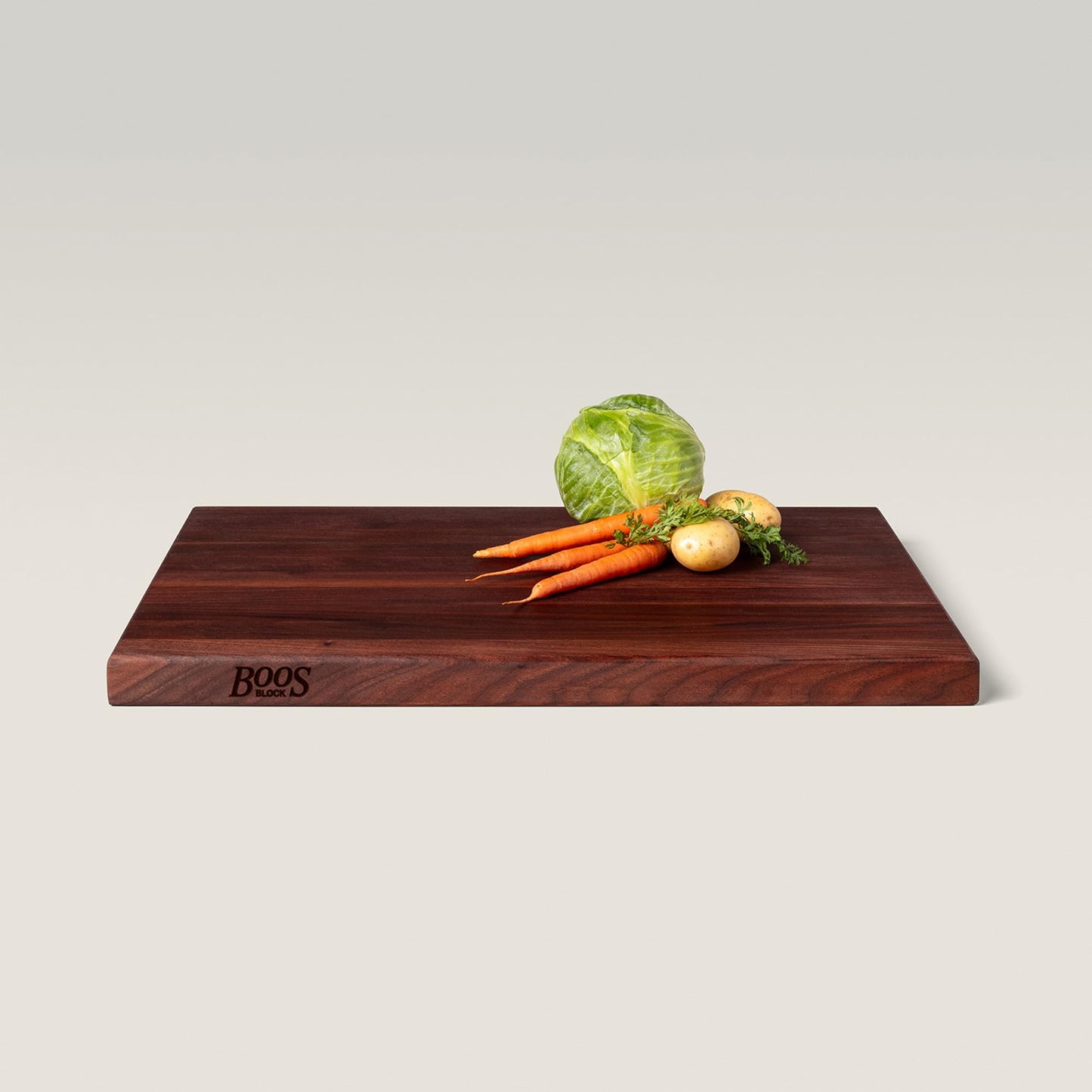
John Boos R-Board Cherry Cutting Board (24" x 18")
A Classic American Edge-Grain Board in Cherry
John Boos has been making butcher blocks in Effingham, Illinois since 1887, and the R-Board is their straightforward, do-everything cutting board. This is the cherry version at 24 by 18 inches and an inch and a half thick, a genuinely large prep surface with room to break down vegetables, carve, and stage a whole meal. It is reversible, with recessed finger grips on each side so a heavy board is easy to lift and flip. As solid American cherry, it is inert and sheds no microplastics, with no coating to wear off.
Cherry is the quietly excellent choice for a cutting board. It is a softer hardwood than maple, which makes it gentle on knife edges, and its close grain and small pores give it natural resistance to bacteria and moisture. It also carries a warm reddish-brown color that deepens with age. The R-Board is edge-grain construction, where the long edges of the wood strips face up. That is not quite as kind to knives as end grain, where the fibers stand vertically, but it is meaningfully more affordable and still far gentler on edges than any plastic, glass, or steel board.
One credential worth stating accurately: the John Boos R-Board line is NSF certified, which is a genuine third-party certification for food-contact safety. That is a real standard, distinct from our own assessment below.
True Shift Score: 8.8 / 10
This is our own assessment, not a lab result, though it is worth noting this board carries a real NSF food-safety certification on top of our view.
It lands just below the end-grain boards for one honest reason: edge grain is a touch less gentle on knives and self-heals a little less than end grain. Everything else is excellent. It sheds no microplastics, it is solid made-in-USA cherry from a brand with a 130-plus-year record, it is large and built to outlast you, and cherry's softness and close grain make it genuinely knife-friendly. For most kitchens this is a practical, beautiful pick, and the small gap from a 9 is about construction nuance, not quality.
The Honest Tradeoffs
1. The honest knock on edge grain is simply that it is not end grain, so for protecting high-end knives an end-grain block edges it out.
2. At 24 by 18 and around 13 to 14 pounds in cherry, it is a large, substantial board, which is a plus for stability and a consideration if your counter or storage is tight.
3. And it carries the usual wood-board upkeep: hand wash, dry promptly, oil regularly, never the dishwasher.
4. Cherry shows its patina over time, which most owners consider part of its charm rather than a flaw.
How We Evaluate Cutting Boards
We look at four things, and none of them is a lab score:
1. Whether the material sheds microplastics,
2. How kind it is to your knives,
3. Whether any glue or finish is food-safe,
4. And how well it lasts with normal care.
Cutting boards are a microplastics-and-glue question, not a PFAS one, despite what some guides imply.

When Something Else Is the Better Fit
- If you want the gentlest possible surface for fine knives, an end-grain board like the WoodForChef walnut or Virginia Boys walnut is the step up.
- If raw meat is your main job and you want a scrub-hard, non-absorbent surface, a stainless steel board is more hygienic, though metal dulls knives.
- For a lighter, cheaper, renewable option, bamboo is the budget pick.
Related Reading and Collections
For the full science on why plastic boards shed and how the materials compare, read our guide to microplastics in cutting boards, and for the wider picture on PFAS and microplastics across the kitchen, see our non-toxic kitchen guide. To weigh other options, browse the full Sustainable Cutting Boards collection, or step back to the Microplastic-Free Kitchen hub for cookware, cooking tools, and food storage. If you would like to work through your whole home step by step, our DIY Healthy Home Guidebooks are a practical place to start.
Frequently Asked Questions
Is cherry a good wood for a cutting board?
Yes. Cherry is a softer hardwood, so it is gentle on knife edges, and its close grain with small pores gives it good natural resistance to bacteria and moisture. It is one of the most knife-friendly woods you can choose.
What is the difference between edge grain and end grain?
Edge grain shows the long sides of the wood strips and is more affordable and lighter; end grain shows the fiber ends standing up and is gentler on knives and better at self-healing. Both are solid wood and shed no microplastics. Edge grain is the value choice; end grain is the premium one.
What does the NSF certification mean?
NSF is an independent certification for food-contact safety, so it tells you the board meets a recognized standard for use with food. It is separate from our own True Shift Score, which reflects our assessment of materials, knife-friendliness, and durability.
About This Product
This board is fulfilled through Amazon, which handles pricing, availability, and shipping. The True Shift earns a commission on qualifying purchases, and that is what keeps this work independent and reader-supported rather than funded by the brands being reviewed.
MAKE THE TRUE SHIFT TODAY
Check current price and availability on AmazonTake the Shift Further
The True Shift Non-Toxic Home Swaps
-
WATER & AIR PROTECTION
Water & Air Protection for a Healthier Home The water you drink...
-
MICROPLASTIC-FREE KITCHEN
The Heart of a Non-Toxic Home The kitchen is where a lot...
-
CHEMICAL-FREE BATH & BODY
Your skin is your body's largest organ, and it absorbs everything you...
-
NON-TOXIC BABY & KIDS' ESSENTIALS
Protect your most vulnerable family members. Vetted, non-toxic alternatives for feeding gear,...
-
HEALTHY HOME OFFICE
Maximize health and focus while you work. Solutions for reducing VOCs from...
-
NON-TOXIC SLEEP & LAUNDRY
Did you know your bed is often the place where chemicals mess...
Microplastic Guides
-
The Plastic-Free Diet 2026: Your 30-Day Bluepri...
The complete 30-day guide to eliminate microplastics, PFAS & forever chemicals from your home. Science-backed steps, product swaps, and real results.
The Plastic-Free Diet 2026: Your 30-Day Bluepri...
The complete 30-day guide to eliminate microplastics, PFAS & forever chemicals from your home. Science-backed steps, product swaps, and real results.
-
How to Create a Healthy Home: A Practical Guide...
Tired of living in a space that doesn’t support you? Learn how to create a healthy, non-toxic home that reflects your core values & goals in just 5 simple steps.
How to Create a Healthy Home: A Practical Guide...
Tired of living in a space that doesn’t support you? Learn how to create a healthy, non-toxic home that reflects your core values & goals in just 5 simple steps.
-
Beyond Plastic: The Modern Approach to Home Org...
Ditch cheap plastic bins and containers for beautiful, non-toxic alternatives. Reduce microplastics, save money, and create a calmer, healthier home with these modern strategies.
Beyond Plastic: The Modern Approach to Home Org...
Ditch cheap plastic bins and containers for beautiful, non-toxic alternatives. Reduce microplastics, save money, and create a calmer, healthier home with these modern strategies.
Sign up for the latest from The True Shift
Receive updates on Healthy Home hacks, lifestyle tips, and other sustainability news.
