
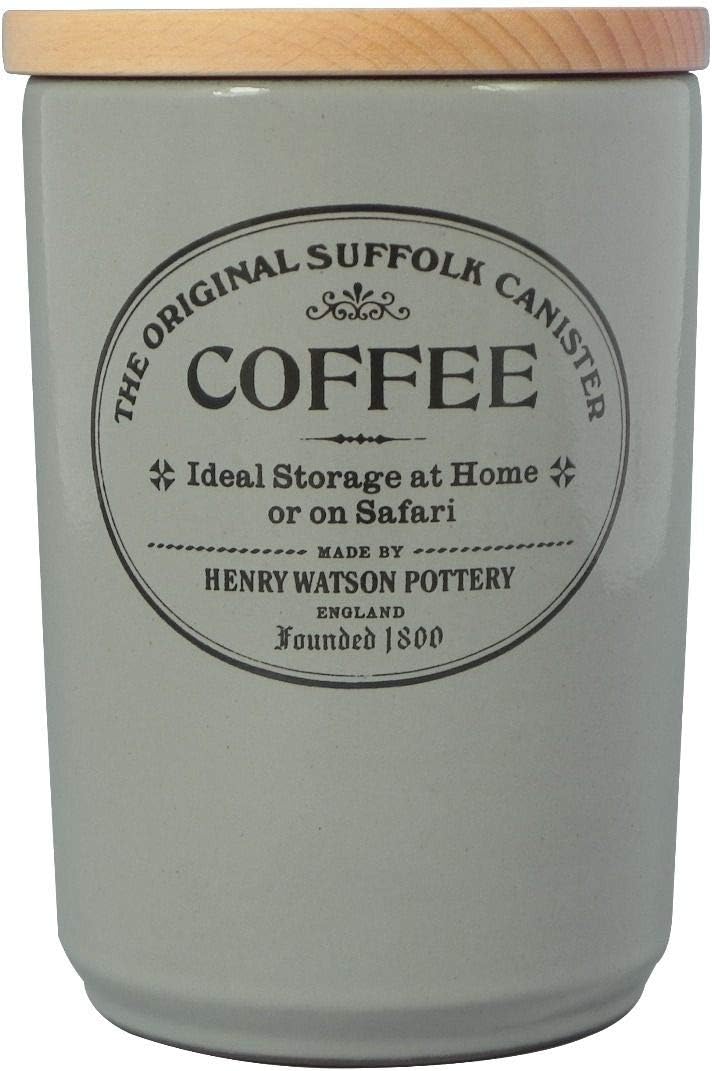
Henry Watson Airtight Coffee Canister, Dove Grey (Made in England)
An English Pottery Classic With a Real Airtight Seal
Some kitchenware has been made the same way for so long that it has become quietly iconic, and the Henry Watson Suffolk canister is one of those.
Made in England by a seventh-generation family pottery that has worked terracotta since 1800, this dove grey coffee canister pairs old-world craft with a genuinely useful airtight seal. Each ceramic body and lid is hand-turned, and the beech wood lid carries a rubber ring that presses down to keep air and moisture out, so your coffee, tea, or sugar stays fresh and dry. The warm grey glaze over the red terracotta clay has a real depth to it, and the whole piece has the heft of something built to sit on a counter for decades.
For a microplastic-free kitchen, the appeal is what it is not made of:
There is no plastic anywhere. The body is glazed ceramic, the lid is real beech wood, and the seal is a rubber ring, so your dry goods rest against glaze and the closure is wood and rubber rather than a plastic snap-top. The ceramic is dishwasher safe, while the wood lid and seal wipe clean.
True Shift Score: 8.0 / 10
This is our own assessment, not a lab result or a certification.
It scores well as a plastic-free, beautifully made English ceramic canister whose closure is wood and rubber rather than plastic, with a genuinely good airtight seal and generations of craftsmanship behind it. It sits in the upper-middle of our scale for honest reasons: the body is glazed terracotta earthenware rather than high-fired stoneware, the listing does not prominently document a lead-free or cadmium-free glaze, and it runs small for coffee. For a charming, plastic-free dry-goods canister with a real seal, it is a solid choice.
The Honest Tradeoffs
A few honest points worth knowing.
1. The body is terracotta, an earthenware rather than a high-fired, fully vitrified stoneware or porcelain, so it is glazed to seal the surface, which is fine for the dry goods these canisters are made for, just know it is a softer-fired clay than something like a stoneware crock.
2. On glaze safety, Henry Watson is an established English maker working to UK food-contact standards, but this listing does not prominently advertise a lead-free or cadmium-free certification the way some pieces in this collection do, so if explicit glaze documentation is your top priority, a maker that states it outright may suit you better.
3. It also runs small: several owners note it does not hold a full standard bag of coffee, so it is best for a working amount rather than bulk.
4. And the wood lid and rubber seal should be hand wiped rather than run through the dishwasher.
None of this is a flaw, it is the honest profile of a traditional glazed-terracotta canister.
How We Evaluate Food Storage
We look at four things, and none is a lab score:
1. Whether the food-contact surface is inert and safe
2. Which for ceramic comes down to the glaze and whether it is free of lead and cadmium
3. Whether the clay body is high-fired and durable or a more porous earthenware
4. What the lid or seal is actually made of and how it holds up over years of use
The real shift in food storage is getting your food off plastic and onto inert materials like glass, steel, and well-made lead-free ceramic.

When Something Else Is the Better Fit
- If you want explicit, well-documented glaze safety, the Emile Henry salt pig states its lead- and cadmium-free credentials clearly, though it is a salt cellar rather than a canister.
- For larger or fully inert dry-goods storage, a glass jar like the Le Parfait or an all-stainless tin like the AUNMAS canister avoids the glaze question altogether.
- This Henry Watson canister is the pick when you want a beautiful, plastic-free English ceramic canister with a real airtight wood-and-rubber lid.
Browse more in the Microplastic-Free Food Storage collection.
Related Reading and Collections
For keeping fruits and vegetables fresh without plastic, see our produce storage guide, and for the wider picture on PFAS and microplastics across the kitchen, read our non-toxic kitchen guide. To weigh other options, browse the Microplastic-Free Food Storage collection, or step back to the Microplastic-Free Kitchen hub for cookware, cutting boards, and cooking tools. If you would like to work through your whole home step by step, our DIY Healthy Home Guidebooks are a practical place to start.
Common Questions About the Henry Watson Coffee Canister
How does the Henry Watson canister stay airtight?
The hand-turned beech wood lid carries a rubber ring that presses down against the rim to seal out air and moisture, keeping coffee, tea, or sugar fresh and dry. The closure is wood and rubber rather than plastic, and the lid and seal wipe clean while the ceramic body is dishwasher safe.
Is the Henry Watson canister lead-free?
It is made in England by an established pottery working to UK food-contact standards, but this listing does not prominently advertise a lead-free or cadmium-free certification. If explicit glaze documentation matters most to you, a maker that states it outright, or an all-glass or all-stainless container, removes the question entirely.
How much coffee does the Henry Watson canister hold?
It runs on the smaller side, and several owners note it does not hold a full standard bag of coffee. It is best thought of as holding a working amount of coffee, tea, or sugar rather than serving as a bulk storage container.
About This Product
This canister is fulfilled through Amazon, which handles pricing, availability, and shipping. The True Shift earns a commission on qualifying purchases, and that is what keeps this work independent and reader-supported rather than funded by the brands being reviewed.
MAKE THE TRUE SHIFT TODAY
Check current price and availability on AmazonTake the Shift Further
The True Shift Non-Toxic Home Swaps
-
WATER & AIR PROTECTION
Water & Air Protection for a Healthier Home The water you drink...
-
MICROPLASTIC-FREE KITCHEN
The Heart of a Non-Toxic Home The kitchen is where a lot...
-
CHEMICAL-FREE BATH & BODY
Your skin is your body's largest organ, and it absorbs everything you...
-
NON-TOXIC BABY & KIDS' ESSENTIALS
Protect your most vulnerable family members. Vetted, non-toxic alternatives for feeding gear,...
-
HEALTHY HOME OFFICE
Maximize health and focus while you work. Solutions for reducing VOCs from...
-
NON-TOXIC SLEEP & LAUNDRY
Did you know your bed is often the place where chemicals mess...
Microplastic Guides
-
The Plastic-Free Diet 2026: Your 30-Day Bluepri...
The complete 30-day guide to eliminate microplastics, PFAS & forever chemicals from your home. Science-backed steps, product swaps, and real results.
The Plastic-Free Diet 2026: Your 30-Day Bluepri...
The complete 30-day guide to eliminate microplastics, PFAS & forever chemicals from your home. Science-backed steps, product swaps, and real results.
-
How to Create a Healthy Home: A Practical Guide...
Tired of living in a space that doesn’t support you? Learn how to create a healthy, non-toxic home that reflects your core values & goals in just 5 simple steps.
How to Create a Healthy Home: A Practical Guide...
Tired of living in a space that doesn’t support you? Learn how to create a healthy, non-toxic home that reflects your core values & goals in just 5 simple steps.
-
Beyond Plastic: The Modern Approach to Home Org...
Ditch cheap plastic bins and containers for beautiful, non-toxic alternatives. Reduce microplastics, save money, and create a calmer, healthier home with these modern strategies.
Beyond Plastic: The Modern Approach to Home Org...
Ditch cheap plastic bins and containers for beautiful, non-toxic alternatives. Reduce microplastics, save money, and create a calmer, healthier home with these modern strategies.
Sign up for the latest from The True Shift
Receive updates on Healthy Home hacks, lifestyle tips, and other sustainability news.
