WoodForChef Heritage Walnut End-Grain Cutting Board
An Heirloom-Grade End-Grain Board, If You Will Care For It
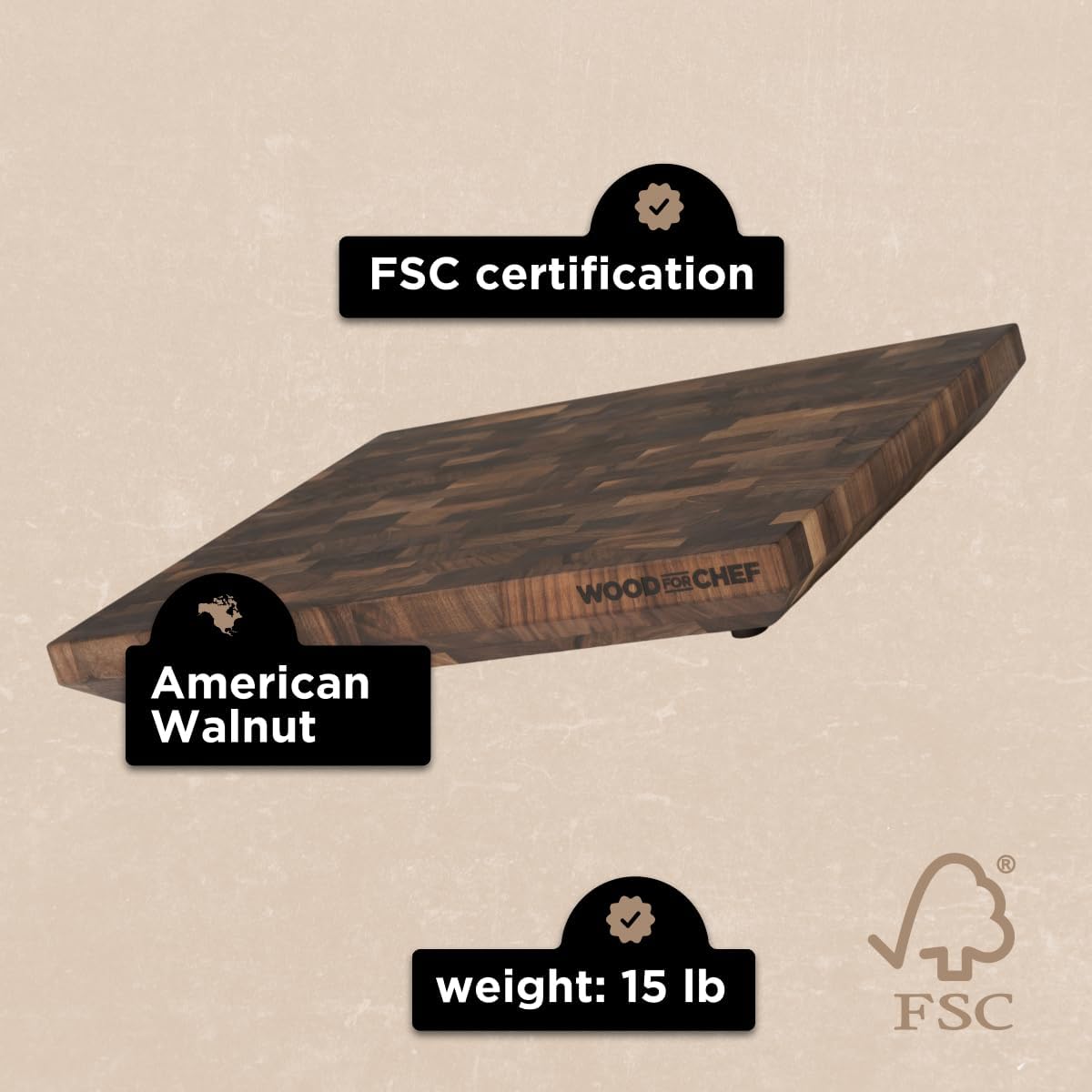
The WoodForChef Heritage is an end-grain walnut block built to be the last cutting board you buy, and for the most part it earns that. End grain is the construction where the wood fibers stand vertically, like the bristles of a brush, so the knife edge slips between the fibers instead of scoring across them. That does two things: it keeps your knives sharper for longer, and the surface "self-heals" as the fibers close back up, so you do not get the permanent grooves that collect on a plastic board. It is a chopping surface that does not shed microplastics into your food, which is the whole reason to leave plastic behind.
The board measures 18 by 16 by 2 inches, which is a serious working footprint, and it sits on raised feet with beveled edges so it is easy to lift and grip. WoodForChef is a small family-run brand, and the boards are made from FSC-certified Canadian hardwood, which is a genuine third-party forestry certification covering responsible sourcing. Worth being precise about what that means: FSC certifies where the wood comes from, not a food-safety lab result, so treat it as a sustainability credential rather than a health seal. The wood itself is solid walnut, an inert natural material with no coating to wear off and nothing to leach.
It ships with an 8.5 ounce bottle of food-grade mineral oil, which is a thoughtful touch because an end-grain board genuinely needs oiling, and starting with the right oil saves you a separate purchase.
True Shift Score: 9.0 / 10
This is our own assessment, not a lab result or a certification.
We rate it highly because it gets the things that matter right: end-grain walnut does not shed microplastics, it is about as kind to knife edges as a board gets, it is solid wood with no questionable glue line doing the heavy lifting, and with basic oiling it lasts for decades. The half point it loses is purely practical, the weight and the required upkeep, which are the price of admission for a board this good. The included food-grade oil and the FSC sourcing nudge it up rather than down.
The Honest Tradeoffs
1. End grain is the most knife-friendly wood surface there is, but it is also the heaviest and the priciest, and this board is both.
2. At two inches thick it has real heft, which is a plus when you are chopping and a minus when you are washing it or moving it around a small kitchen.
3. It also asks for upkeep: hand wash only, dry it promptly rather than letting it sit wet, and re-oil it every few weeks at first and then monthly, or the wood can dry and crack over time.
4. None of that is hard, but it is not a dishwasher-and-forget board, and if that is what you want, this is the wrong one.
How We Evaluate Cutting Boards
We look at four things, and none of them is a lab score:
1. Whether the material sheds microplastics
2. How kind it is to your knives
3. Whether any glue or finish is food-safe
4. And how well it lasts with normal care
Cutting boards are a microplastics-and-glue question, not a PFAS one, despite what some guides imply.

When Something Else Is the Better Fit
- If you want most of the knife-friendliness for less money and weight, an edge-grain board like the John Boos maple R-Board is the more sensible everyday choice.
- If you handle a lot of raw meat and want a surface you can scrub hard with nothing to absorb, a stainless steel board is more hygienic, though it will dull your knives.
- And if you want a lighter, lower-cost board and do not mind a little glue in the construction, bamboo is the budget pick.
Related Reading and Collections
For the full science on why plastic boards shed and how the materials compare, read our guide to microplastics in cutting boards, and for the wider picture on PFAS and microplastics across the kitchen, see our non-toxic kitchen guide. To weigh other options, browse the full Sustainable Cutting Boards collection, or step back to the Microplastic-Free Kitchen hub for cookware, cooking tools, and food storage. If you would like to work through your whole home step by step, our DIY Healthy Home Guidebooks are a practical place to start.
Frequently Asked Questions
Is an end-grain board worth the extra cost over edge grain?
If you care about your knives and want the longest-lasting surface, yes. End grain is gentler on edges and self-heals better than edge grain. If budget or weight is the priority, a good edge-grain board gives you most of the benefit for less.
How do I take care of it?
Hand wash with mild soap, never the dishwasher, and dry it standing up so air reaches both faces. Oil it with food-grade mineral oil (the bottle is included) every few weeks at first, then about monthly. That is all it takes to prevent drying and cracking.
Does a wooden board hold bacteria?
No more than plastic, and research suggests less. Wood tends to draw bacteria below the surface where they dry out, while the knife grooves in a plastic board can shelter them. Wash and dry it properly and it stays hygienic.
About This Product
This board is fulfilled through Amazon, which handles pricing, availability, and shipping. The True Shift earns a commission on qualifying purchases, and that is what keeps this work independent and reader-supported rather than funded by the brands being reviewed.
MAKE THE TRUE SHIFT TODAY
Check current price and availability on AmazonTake the Shift Further
The True Shift Non-Toxic Home Swaps
-
WATER & AIR PROTECTION
Water & Air Protection for a Healthier Home The water you drink...
-
MICROPLASTIC-FREE KITCHEN
The Heart of a Non-Toxic Home The kitchen is where a lot...
-
CHEMICAL-FREE BATH & BODY
Your skin is your body's largest organ, and it absorbs everything you...
-
NON-TOXIC BABY & KIDS' ESSENTIALS
Protect your most vulnerable family members. Vetted, non-toxic alternatives for feeding gear,...
-
HEALTHY HOME OFFICE
Maximize health and focus while you work. Solutions for reducing VOCs from...
-
NON-TOXIC SLEEP & LAUNDRY
Did you know your bed is often the place where chemicals mess...
Microplastic Guides
-
The Plastic-Free Diet 2026: Your 30-Day Bluepri...
The complete 30-day guide to eliminate microplastics, PFAS & forever chemicals from your home. Science-backed steps, product swaps, and real results.
The Plastic-Free Diet 2026: Your 30-Day Bluepri...
The complete 30-day guide to eliminate microplastics, PFAS & forever chemicals from your home. Science-backed steps, product swaps, and real results.
-
How to Create a Healthy Home: A Practical Guide...
Tired of living in a space that doesn’t support you? Learn how to create a healthy, non-toxic home that reflects your core values & goals in just 5 simple steps.
How to Create a Healthy Home: A Practical Guide...
Tired of living in a space that doesn’t support you? Learn how to create a healthy, non-toxic home that reflects your core values & goals in just 5 simple steps.
-
Beyond Plastic: The Modern Approach to Home Org...
Ditch cheap plastic bins and containers for beautiful, non-toxic alternatives. Reduce microplastics, save money, and create a calmer, healthier home with these modern strategies.
Beyond Plastic: The Modern Approach to Home Org...
Ditch cheap plastic bins and containers for beautiful, non-toxic alternatives. Reduce microplastics, save money, and create a calmer, healthier home with these modern strategies.
-
AI for a Toxin-Free Home in 2026: How It Create...
Discover how AI for a toxin-free home works in 2026. Get an AI-powered healthy home audit, personalized swaps, and science-backed recommendations to eliminate microplastics, PFAS & phthalates effortlessly.
AI for a Toxin-Free Home in 2026: How It Create...
Discover how AI for a toxin-free home works in 2026. Get an AI-powered healthy home audit, personalized swaps, and science-backed recommendations to eliminate microplastics, PFAS & phthalates effortlessly.
Sign up for the latest from The True Shift
Receive updates on Healthy Home hacks, lifestyle tips, and other sustainability news.
